

Your House Won’t Burn Alone
Technology Opportunities and Evolution Of Fire Tactics:
Reflections on WUI Fires, Disruption, and the Opportunity Hidden in the Chaos
In the last few years, I’ve found myself thinking differently about wildland-urban interface (WUI) fires. I come at this with a foot in both worlds — as a firefighter and as someone who’s spent the last decade in fire technology, working alongside agencies trying to build, test, and integrate new tools.
I’m not here to tell anyone how to fight a fire, and I’ve learned more from listening and observing on the fireground than I have from any textbook. But I’ve started to see some patterns — especially in WUI incidents — that I think are worth talking about.
Because something fundamental has shifted. And with that shift, I think there’s an evolved kind of tactical opportunity hiding in plain sight.
The Fire Itself Has Evolved
The old line between “wildfire” and “structure fire” has blurred. Under impinging wildfire conditions, there are no true “single structure fires.” Once fire gets a toehold in a neighborhood, each structure becomes a domino ignition point. One lights, and the heat, embers, and radiant and convective exposures set off the others around it.
Some recent events made this painfully clear:
In Paradise, embers traveled well ahead of the main fire, igniting homes in clusters long before crews arrived.
In Lahaina, homes ignited without visible flame — a mix of ember intrusion, radiant heat, and hyperlocal wind effects.
In the Marshall Fire in Colorado, winds over 100 mph pushed a grass fire directly into suburban neighborhoods. Structure-to-structure ignition became the dominant spread mode within minutes.
In the Palisades Fire in Los Angeles, flames entered one of the most densely developed WUI zones in California. Spot fires were observed over half a mile ahead of the flame front, carried by gusts of 25–30 mph.
These weren’t forest fires. They were urban conflagrations, seeded by wildfire conditions. Unlike in the wildland, where fire typically advances following a geography, or in cities where most fires stay confined to a single building, WUI fires can ignite dozens of points simultaneously. They are not perimeter problems, but cascade problems.
Why WUI Fires Are a Different Animal
Scale. A house fire might peak at 1,100–1,500°F (600–800°C). A crown fire in a forest can reach 1,800°F (1,000°C). But a fully engaged neighborhood firestorm can easily exceed 2,000°F (1,100°C), with radiant loads high enough to melt glass and ignite vehicles without direct flame contact. Extreme heat often produces strong vortex updrafts which in turn can generate local wind gusts above 40 mph - essentially a blow torch. This means the effective rate of spread can reach one to two miles per hour, consuming entire subdivisions in a matter of hours.
Environment. Forests naturally dampen surface winds. Communities do not. Instead, gridded streets and open yards act like wind tunnels. The result is rapid heating from blown air — the same principle as a forge bellows — which accelerates pyrolysis and ignition.
Spread. Traditional wildfire tactics — bulldozed fire lines, controlled back-burns — don’t work in neighborhoods. You can’t bulldoze through houses or light backfires in cul-de-sacs. Aerial drops that buy time in forests do little to slow structure-to-structure ignition at community density.
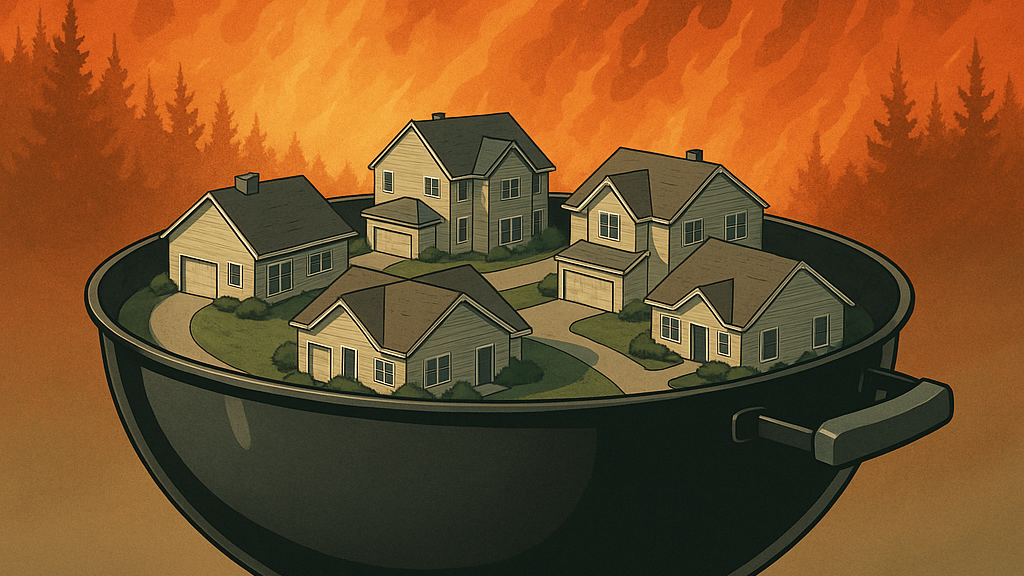
The charcoal briquet problem. A neighborhood under wildfire assault isn’t a collection of isolated homes. It’s more like a bed of charcoal briquets: uniformly spaced, pre-conditioned, and radiating heat into each other. Once one briquet lights, it doesn’t stay contained — it quickly transfers its energy to the next.
Spraying water on a single briquet may cool it temporarily, but it does little to stop the fire from spreading across the pile. To break the cycle, you have to separate the briquets, thin the cluster, or disrupt the shared heat.
That’s what makes WUI fires so unforgiving. Each house is not just a victim; it’s an ignition source feeding the others. And the only real defense is to disrupt the cascade before it self-sustains.
The Real Enemy Is the Cascade
Most losses don’t happen because a perimeter collapsed. They happen because one ignition wasn’t stopped, and it triggered a chain reaction:
An ember lands in a woodpile.
That fire breaches an attic.
The heat and flame from that structure ignite three others.
Within minutes, you have a block fire.
It’s less like a forest fire spreading and more like electrical arcing — a flashover across a circuit of homes. Or a gymnasium full of mousetraps set with ping-pong balls: one goes off, and dozens follow. You don’t stop the cascade by chasing every ball midair. You stop it by breaking the chain reaction.
Disruption Over Suppression
Suppression is still vital. But in WUI firestorms, it isn’t enough (and in many cases there is not sufficient time, personnel, or water to mount individual suppression efforts). The better question is: where can we disrupt the transitions — the moments when one ignition turns into ten?
That might mean:
Automatically activating foggers or localized sprinklers when embers land (before flames are visible).
Using positive pressure to keep smoke and heat out of attics or crawlspaces.
Coating fence lines or decks with rapid-deploy gels or foams that slow radiant transfer.
Pre-event humidity boosting or automated overpressure vents on red-flag days.
Individually, none of these necessarily save a town. But tactically, they can keep one house from becoming three. And when that happens, the fire curve bends downward, fast. That should be out tactical objective.
This is the principle of disruption. In guerilla warfare, smaller forces succeed by cutting supply lines and ambushing edges instead of fighting head-on. In public health, pandemics are controlled not only by treating patients but by cutting vectors — mosquitoes, sanitation, vaccines, and driving herd immunity. WUI defense may require a similar mental shift.
Shared Sensing and Reflexive Defense
Nature shows us how. Prairie dogs chirp warnings when a hawk appears and the whole colony dives. Trees under insect attack release chemical signals to nearby trees. In biology, early warning and local response are reflexive, distributed, and contagious.
The same can work in WUI defense:
Thermal and air-quality sensors detect embers, radiant heat, or pyrolysis.
Low-power radio networks like LoRa carry alerts without cell towers.
Smart vents, foggers, and LEDs trigger automatically.
One house senses a problem, and the entire block shifts into “fire-defense mode.” Not because a dispatcher issued an order, but because the system sensed the risk and reacted.
The Opportunity Hidden in the Chaos
The core tools already exist: mesh radios, modular sensors, predictive models. What we’re missing isn’t invention — it’s integration and deployment. The connective tissue.
The real opportunity is to act before a conflagration fully takes hold, when infrastructure is still intact and untaxed, and automation can still work. By treating each house as a node in a community-scale defense network, we can break the cascade before it sustains itself.
There’s no silver bullet. But I’m convinced that disruption — both as a mindset and as a tactical function — is a path worth pursuing.
I’m currently working with technologists, emergency operations groups, and frontline users to explore how we can get the right tools into firefighters’ hands — and into neighborhoods — in time.
If you’re tackling these challenges too — as a responder, technologist, policymaker, or neighbor — I’d welcome the chance to connect.